From CAD file to functional part in a few days
With 3D printing for the automotive industry, you get prototypes, fixtures and spare parts in a few days, without tooling costs.
When a prototype or other functional component is to be manufactured, conventional manufacturing means developing tools, molds or milling programs. This often means waiting several weeks before the first part is available and often at a fairly high cost. With 3D printing, you upload the CAD file, choose materials and have the part with you in a few days. Of course, you can also Contact Us to discuss your needs, we are happy to help.
The unit price is barely affected if you order ten of the same part or ten different variants to compare in parallel. You pay for material and machine time, not for tools and start-up.
Because we use FDM, SLA, SLS, MJF and DMLS, the same order can contain both plastic parts and metal parts, which means you don't have to deal with several different suppliers.
Electrification has made weight even more important and vehicles, if possible, even more compact and space-efficient. Battery mounts, engine mounts and cooling shrouds must be lightweight but able to handle the same loads, often in an increasingly confined space.
When a part is built layer by layer, material can be added where it is needed and ”removed” where it is not needed. Lattice structures and organic shapes that cannot be cast or milled become possible, which can often increase the performance of the parts. A topology-optimized part in DMLS aluminum can weigh significantly less than a cast or milled equivalent and still be just as stiff.
Are you new to design for additive manufacturing (DFAM)? We're happy to review your file and suggest changes before we print.
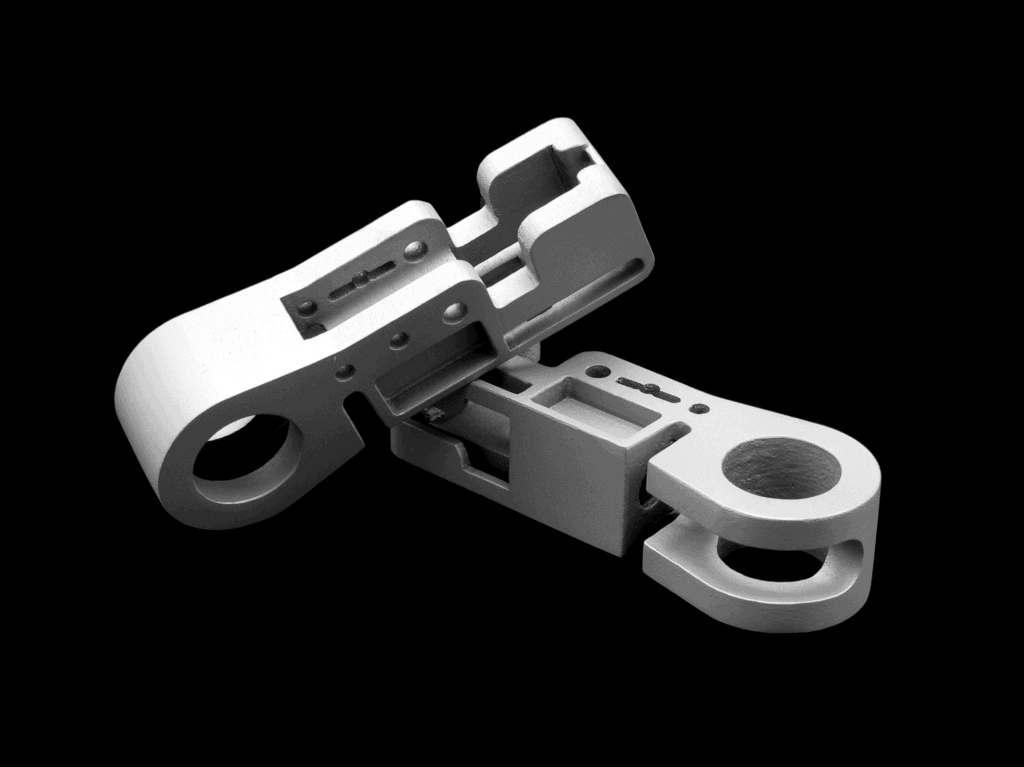
At Freevalve AB, which develops camshaft-free valve control for combustion engines, we printed an aluminum component using DMLS. The part was CNC-machined after printing and used in functional tests. It's the one you see in the picture.
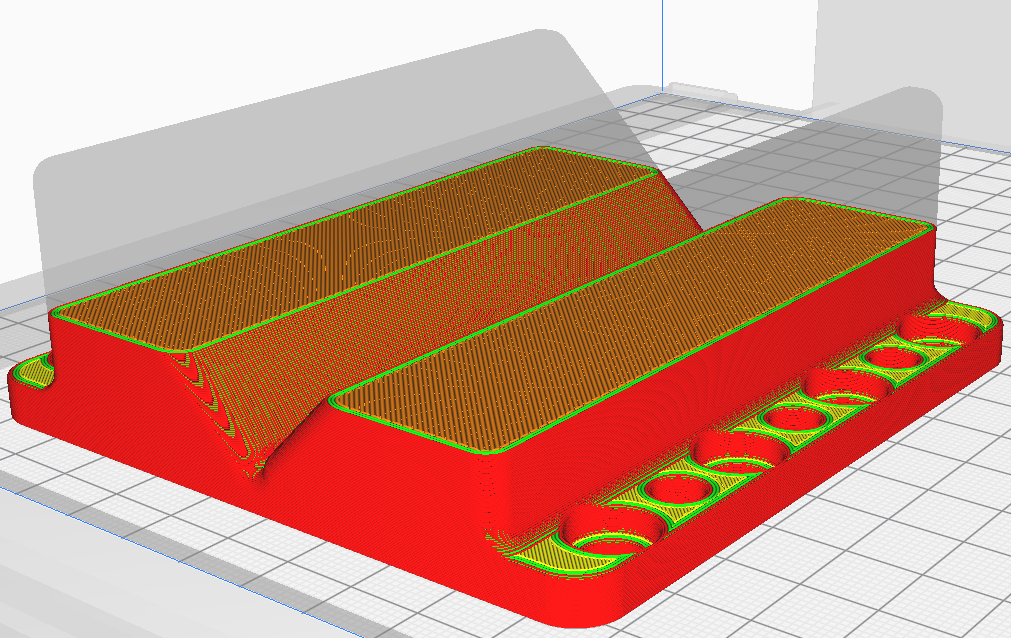
Prototypes are what many people think of first, but in automotive production, it is often jigs and fixtures that save the most money. To produce them conventionally takes weeks. Printed, they are ready in a few days.
Each fixture can be shaped exactly to your line, and when the product changes, you make a new version. Carbon fiber reinforced polyamide in FDM is stiff enough for industrial handling and much lighter than a metal fixture, something operators notice after an entire shift.
We have developed production tools for vehicle manufacturers such as AB Volvo and Scania that are used in manufacturing.
Vehicles have a long lifespan, and spare parts are often needed long after the model has been discontinued. Storing them for decades costs money and takes up floor space. With the CAD file as an archive, the part can instead be manufactured when someone needs it.
With print on demand We will become your digital spare parts warehouse and you only need to let us know which part and quantity you need, regardless of whether it is a single part for a service assignment or a smaller series for your internal warehouse.
Structural parts and motorsport components with geometries that cannot be cast or milled.
Material: Aluminum AlSi10Mg, titanium Ti-6Al-4V, stainless steel 316L
Durable prototypes and housings that withstand mechanical tests.
Material: PA12, glass-filled PA
Jigs, fixtures and other aids for the assembly line.
Material: Carbon fiber reinforced polyamide, ABS, ASA, PETG
Holders, wiring details and other serial parts with a smooth surface directly from the machine.
Material: PA12, PA11, TPU, PP
Sharp details for visual prototypes and fit checks.
Material: UV-curing resin
Try our process and material selector, or hear from you so we will help you choose.
Most of our materials are used in industrial production and have documented mechanical properties and temperature resistance. Requirements for, for example, fire classification or food contact differ between materials. Tell us what your requirements are and we will answer what applies.
Plastic parts in FDM, MJF and SLA normally take 2–5 working days and SLS 3–7 days. Metal parts in DMLS take 10–15 days depending on geometry and quantity. If you are in a hurry, let us know when you order and we will see what we can do.
SLA gives the highest precision and smoothest surface. MJF gives a smooth, dense surface straight from the machine. FDM has visible layers and is best suited where the surface is not as important, such as in fixtures. We can also sand, prime or vapor smooth on, for example, PA12.

Yes. We review the file and point out things that affect the result, such as wall thickness, support material and tolerances. If you need more extensive design assistance, we can do it as a separate assignment.
Yes, we ship to all of the Nordic countries and also within the EU. Please contact us if you would like to know more about shipping and customs.
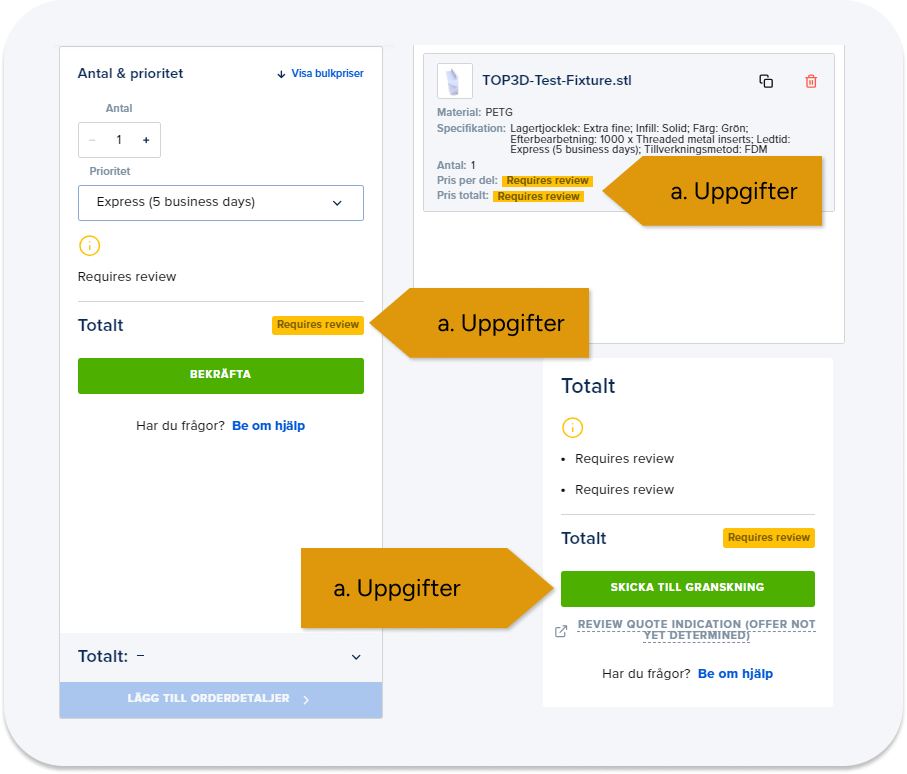
Upload your file to get a price directly, or Contact Us if you want to talk through the project first. You can find more about our techniques under processes and materials and 3D printing in metal.
You will receive a quote within 24 hours.