Here you will find answers to the most common questions about 3D printing, material selection, ordering and production. We have gathered all the information you need to move your project forward quickly – from technical specifications and material recommendations to practical questions about pricing, delivery times and applications.

We help companies develop prototypes, functional parts and end products through 3D printing in plastic, composites and metal. From 3D file to finished delivery.
Yes, our services are aimed exclusively at registered companies.
Absolutely. We guide you in choosing 3D printing materials, process and design so that you get the right type of product.
Manufacturing, electronics, medical technology, product development, automotive, drones, energy, research, architecture, design and many more.
Everything from prototypes, machine components, enclosures, fixtures, spare parts and camera guards to advanced technical parts in metal.
Common to all 3D printing processes is that parts are always built up layer by layer. The part to be made is divided into a large number of cross-sections, called layers, a few tenths of a millimetre thick. These layers form the basis of 3D printing, in both plastic and metal.
Nylon PA12 with SLS or with MJF – lightweight, impact-resistant, dimensionally stable and allows complex shapes.
ASA or Nylon PA12. ASA is especially UV-resistant.
Metal (aluminium, stainless steel, titanium), PEEK/PEKK or high-temperature composites PPA-CF, PEHT-CF. PLA and PETG do not.
Nylon PA12, carbon-fibre-reinforced nylon materials (PAHT-CF or PPA-CF) or 3D printing in metal depending on the load.
Yes, TPU is perfect for flexible protection, vibration and shock absorption.
Yes, for example aluminium, titanium, stainless steel and tool steel.
PEKK, Nylon, some composites and stainless steel.
Nylon PA12, ASA or PETG depending on the application.
Yes and no, some SLA materials can be made transparent. The materials are translucent, which means they look milky or smoky. The core of the material is transparent but the surfaces are matte, so the parts are not clear and you cannot see straight through them. However, the parts can be polished and lacquered to make them clear and more transparent.
Yes – we offer dyeing, painting, polishing and surface treatment.
You can 3D print in almost any material, from plastic and metal to wood and concrete. We offer manufacturing in a wide range of thermoplastics, thermosets, metals and composites. Read more about our processes and materials for 3D printing.
The strength of 3D printing is generally very good. 3D-printed aluminium has about the same strength as cast aluminium, and steel is on a par with forged steel. Some people believe that 3D-printed parts do not hold up, but in those cases the wrong material or process has usually been used for the purpose.
These processes produce very similar results and material properties, but the processes are very different. Both processes build geometries by melting a powder. In SLS, the powder is fused together with a laser, while in MJF, the powder is fused using a heat lamp and a form of heat-attracting ink. If we are talking about PA12 (nylon12), details made with SLS will be white and details made with MJF will be grey. Both can be colored in.
It is definitely MJF, but I am not sure whether PA12 Standard or PA12S Smooth is the closest, so you will need to order one of each and evaluate them yourself.
The most UV-resistant material we offer, in terms of plastics, is ASA. There are other options too, but ASA is by far the most UV-resistant.
By far the best material for outdoor use is ASA. ASA is manufactured with the process FDM. We also have other suitable materials, but in that case I would ask you to send us an enquiry so we can go through your specific needs and find the best solution for you.
The choice of material and process depends on your needs. Find suitable materials in our easy-to-use material and process selector.
Yes – this is common, especially in Nylon PA12.
Yes – propeller guards, chassis components, gimbal parts, mounts and brackets can all be 3D printed. Two commonly used materials are PAHT-CF and PA12S Smooth.
Yes, including heat-resistant and water-protected solutions.
Yes – provided there is a 3D model or we can create one using what is known as Reverse Engineering.
Yes – TPU or Nylon are good choices.
Yes, anatomical models and surgical planning models are often printed in resin, while implants are 3D printed in PEKK and Titanium.
Yes – Nylon PA12, PA11, composites and 3D printing in metal are common.
Yes – Nylon PA12, TPU, PEKK and some composites work excellently at low temperatures.
Yes, PA12S Extra Smooth is a very good material for watertight and pressure-tight applications.
Yes – both functional prototypes and visual models.
.STEP and .STL. Each part should be its own file.
Nylon 0.8 mm. Metal even thinner. The recommended minimum thickness is 1–1.5 mm.
Yes – but metal inserts are recommended for threads under load.
Yes – 3D printing is perfect for geometries that are impossible with traditional manufacturing.
Depending on the process: ±0.1–0.3 mm is common for plastic. Metal has even better tolerances.
Yes, but the maximum size varies by material. A large object can be split and joined.
Yes – they can be built directly into the model.
Yes – we can suggest wall thickness, orientation, material and support strategy.
The maximum print size depends on material and process. To give you a rough idea, it is in the region of about 40 cm for plastic and metal. Please upload your part to our online tool where you can see whether your part can be manufactured. Sometimes we can split a part and make it in several pieces if it does not fit in our machines. If you find that your part does not fit after uploading it, feel free to Contact Us and we will see whether we have a good solution for splitting it.
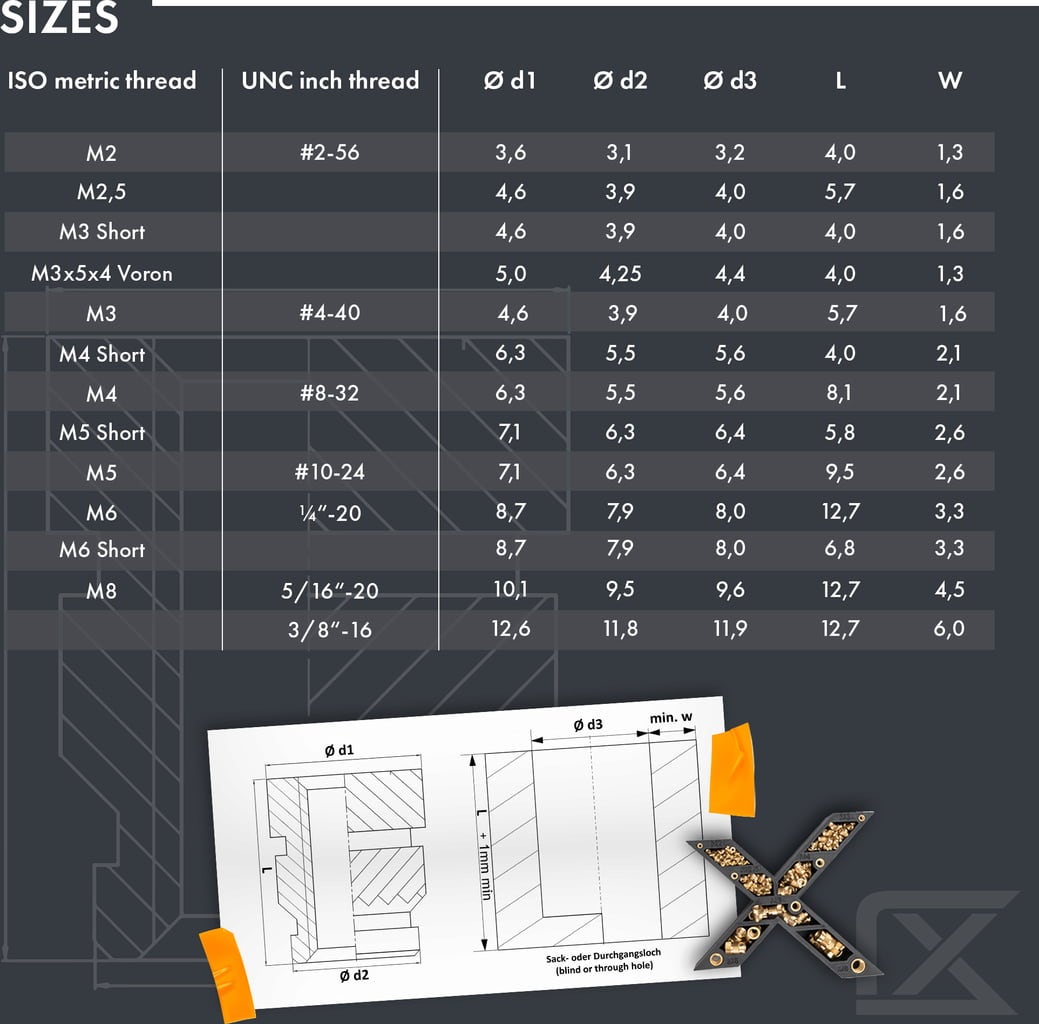
I this picture you can see how to dimension the holes for inserts in 3D-printed parts. We offer more insert heights than shown in that picture, but you can see the width of the holes and the wall thickness around them there. We always double-check that the holes have the right dimensions when you have specified inserts in your order, so you do not need to worry about mistakes.
Upload a 3D file to our online tool, choose material and process, get a price/quote, then production and delivery.
You are welcome to, and our process and material selector is a great help, but we are happy to make recommendations based on your requirements.
It depends on material and volume: anything from express (1–2 days) to standard (5–15 days).
Exact times depend on the chosen process.
Yes – you can order the design and creation of a 3D model.
Yes – 3D printing can be cost-effective for both small and medium volumes, and the best fit here is usually MJF .
We will get back to you with recommended adjustments or suggested changes.
Yes – many materials can be printed express. Contact Us for urgent projects.
We have developed a material selector where you can easily filter by material properties to find the material that best meets your requirements.
Mainly by the volume (size) of the model and the material. Geometry and complexity rarely affect the price.
The minimum order is SEK 2,000 excl. VAT & shipping.
It depends on material and volume: anything from express (1–2 days) to standard (3–10 days).
The price varies by material and size – we provide a quote when the 3D file is uploaded.
Yes – metal is a premium process and costs more in both material and machine time.
Yes – the price per part often drops with series production.
Size, weight and the chosen shipping service.
3D printing has no start-up cost and is therefore often cheaper than traditional manufacturing for low-volume production and small series. The cost of 3D printing is calculated from the 3D file of the component, and the size of the part is the main factor determining the price. High complexity rarely costs extra, which is not the case in traditional manufacturing. Our minimum order value is SEK 2,000 excl. VAT and shipping.
In order for us to calculate prices for manufacturing, you need to provide us with:
If you don't have a 3d file, one must be produced, which we are happy to help with. Contact us for more info if you need help with this.
Unfortunately I cannot give you a straight answer to that. It depends on many factors, such as the material, the amount of support required and the design of the part, to name a few. We do not have prices per gram. You need to upload your file to our online tool to get a price for your parts.
The cheapest material is usually PLA made with FDM or PA12 Standard made with MJF. However, prices are calculated from the 3D model of the part in question, so it may differ for your particular part. The best approach is to upload it to our online tool to get the correct price and compare different processes, materials and lead times.
Our minimum order value is SEK 2,000 excluding VAT and shipping. With 3D printing there is no start-up cost for tools and moulds, which often makes it cheaper than traditional manufacturing for single items and small series. The cost of 3D printing is based on your choice of material and the 3D file of the component, with the size of the part being the main factor determining the price. High complexity rarely adds extra cost, which is usually the opposite of traditional manufacturing.
Polishing, dyeing, painting, CNC post-processing, threaded inserts and surface treatment.
Yes, especially with SLA or with various types of post-processing.
Yes – we install metal inserts of various kinds.
In that case I would recommend SLA. SLA prints have the best surface finish but cost a little more than other processes. In practice anything can be painted, and if you want a slightly cheaper option I would suggest looking at FDM or SLS which is normally priced lower than SLA. But SLA is the easiest to work with and gives the best finish.
We offer a range of post-processing services, including CNC machining, painting, polishing and installation of inserts.
Yes – as long as there is a model or a drawing.
Yes – very common in industry. We use Reverse Engineering for this.
Yes – Nylon works excellently.
Yes – using resin, SLS with colour or post-processing.
Yes – prototypes are a central part of what we offer.
Yes – it is often the most cost-effective choice.
The quick answer is about 40 cm. The maximum build volume of each process can be found under that process, but that information does not always answer the question. Some parts have to be split in order to be printed, usually not because of their size, but simply because it is much more cost-effective to 3D print them that way. Some have to be split because quality and tolerances require it. A certain type of finishing is often requested, and then other dimensions apply than the maximum build volume of the 3D printer in question.
So, the answer depends on many different parameters. Send us your request and we will look at how we can best manufacture your part and whether it should be manufactured in one piece or in parts that are assembled before delivery.
Yes, we can do that – this is called Reverse Engineering. We ask you to send us pictures of the part along with a description of the material it should be made of and any tolerances. We will then get back to you with a quote for creating the part as a 3D model and manufacturing it. Please do not send the part to us until you have received and approved a quote.
Yes – it produces minimal waste and requires no tooling.
Yes – we can provide data sheets and material properties when needed.
Yes – our materials are used in professional production across many industries.
Yes – from Malmö to Norrland.
Yes – we offer advice on material selection and design, Contact Us.
Yes – we can sign a non-disclosure agreement when needed.
Yes – we can optimise files for better print results.
Lead times vary depending on the complexity of the project and the materials used, but we aim to deliver as quickly as possible, typically from 0 to 15 working days.