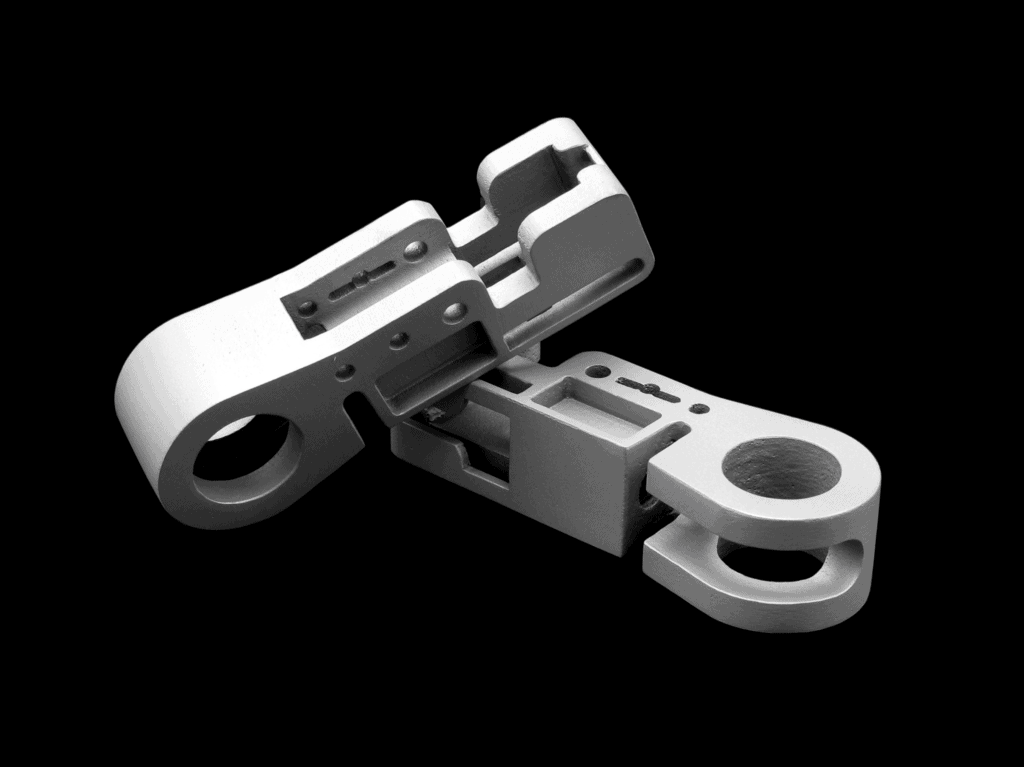
Ti₆Al₄V is a high-performance alloy characterised by its strength, low weight and exceptional corrosion resistance. It is widely used in aerospace, aviation, automotive and medical engineering thanks to its excellent mechanical properties and is ideal for prototypes and end products.
Ti₆Al₄V is a popular titanium alloy in the aerospace, aviation, medical and automotive industries due to its high strength, corrosion resistance and low weight. The alloy is particularly suitable for 3D printing using techniques such as selective laser melting (SLM), which produces high density and fine microstructures. The rapid cooling during the printing process results in improved mechanical properties of the 3D printed material compared to traditionally processed Ti₆Al₄V.
3D printed components made of Ti₆Al₄V are common in high-performance applications, such as aircraft parts, implants and motorsports parts. The material is also biocompatible, making it ideal for medical implants that need to withstand prolonged stress and biological contact. The printed parts can be machined, ground and surface-finished in the same way as conventionally manufactured components, which provides great flexibility in post-processing.
High strength and low weight
Excellent corrosion resistance
Biocompatibility for medical applications
Used for functional prototypes and final products
3D printed titanium is not automatically food-safe. For a material to be food-safe, it must meet specific rules and standards set by food authorities, such as the EFSA (European Food Safety Authority) in Europe or the FDA (Food and Drug Administration) in the United States.
Titanium itself is biocompatible and is used in medical applications such as implants, meaning it is not harmful to the human body. However, as with any use of materials that come into contact with the body or food, it is important to ensure that your 3D printed titanium products are processed and surface treated in a way that prevents contamination or unwanted chemical reactions, and that you certify them for their intended use. Contact Us for more information.
Material data
As printed
Tensile strength: 900MPa
Elastic limit: 830MPa
Elongation at break: 10%
E-modulus: 110000MPa
Maximum operating temperature: 400°C
Infill rate: 100% solid
Hardened 980MPa
900MPa
14%
110000MPa
400°C
Material data
Tensile strength:
Elastic limit:
Elongation at break:
E-module:
Maximum operating temperature
As printed 900MPa
830MPa
10%
110000MPa
400°C
Material data as printed:
Tensile strength: 900MPa
Elastic limit: 830MPa
Elongation at break: 10%
E-modulus: 110000MPa
Maximum operating temperature: 400°C
Infill rate: 100% solid
Hardened Tensile strength: 980MPa
Elastic limit: 900MPa
Elongation at break: 14%
E-modulus: 110000MPa
Maximum operating temperature: 400°C
Process data Standard tolerance: ± 0.4% (lowest limit ±0.4 mm)
Layer thickness: 30-60 μm
Minimum wall thickness: 1
Minimum detail level: 0.4
Surface finish (blasted): Ra 9 - 15
Largest component size: 300
Characteristics
BiocompatibleHigh strengthChemical resistantCorrosion resistant/stainless steelLightweightFood authorisedResistant to ironingRigidOutdoorsUV-resistantThermally conductiveWater resistant